What is the Orthodox Church?
Who we are
The Orthodox Church is the Christian Church of the first thousand years, continuing unbroken to today. It is the Church of the apostles, of the New Testament, of the martyrs, of the councils that gave the world the Nicene Creed, and of the men and women who built the monasteries and cathedrals of the Christian East.
For the first thousand years there was one Christian Church, with centers in Rome, Constantinople, Alexandria, Antioch, and Jerusalem. In 1054 the Church of Rome and the four Eastern churches separated, in a break that has never been fully healed. The Eastern churches became known as Orthodox, from the Greek for “right belief” and “right worship.” Five hundred years later, the Protestant Reformation began in the West. The Orthodox Church was not part of either the Roman Catholic Church or the Protestant churches that came out of it. It simply continued.
Today Orthodox Christians live throughout Eastern Europe, the Middle East, and, increasingly, the Americas. In the United States, Orthodox parishes are organized in several jurisdictions. All share one faith and one Communion. St. Mary’s belongs to the Antiochian Archdiocese.
What we believe
Orthodox Christians believe in one God, the Father, the Son, and the Holy Spirit. We believe that God the Son became a human being, Jesus Christ, born of the Virgin Mary; that he taught, healed, was crucified, died, and rose from the dead; and that in his resurrection he defeated death for all of us. We believe he founded a Church, sent the Holy Spirit upon it at Pentecost, and remains present in it.
We believe that human beings were made in the image of God, that we have turned away from him, and that Christ came to restore us. Salvation is not a legal transaction but a healing: God became what we are so that we might become what he is, as St. Athanasius put it in the fourth century. The Christian life is the process of that healing, called theosis, and it happens through prayer, the sacraments, the Scriptures, fasting, generosity, and love of neighbor.
Our beliefs are summarized in the Nicene Creed, written at the Councils of Nicaea (325) and Constantinople (381), which we say aloud at every Divine Liturgy. We hold the Scriptures to be the inspired word of God, read within the Church that produced and preserved them. We honor Holy Tradition, the life of the Church as it has been lived and taught since the apostles, of which Scripture is the heart.
How we worship
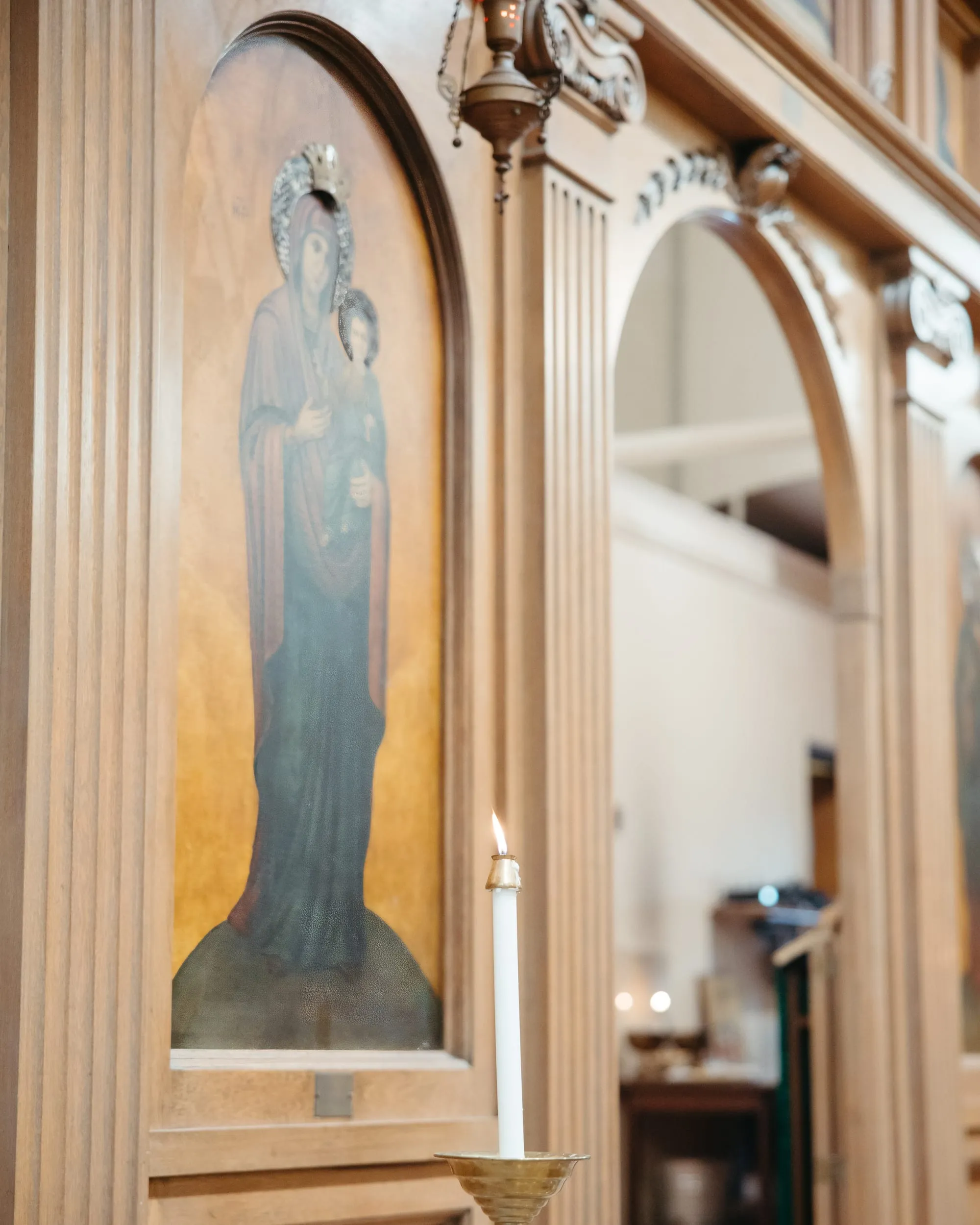
If you visit St. Mary’s, you will notice first that nearly everything is sung or chanted, and that the whole service is offered to God. The priest faces the altar with the people, because everyone is facing the same direction, toward God. There are icons on the walls and on the screen in front of the altar, incense in the air, candles burning. Worship here involves the body: standing, bowing, making the sign of the cross, kissing icons, tasting bread and wine.
The main service is the Divine Liturgy, which has been celebrated in nearly the same form since the fourth century. Its center is the Eucharist, in which we believe the bread and wine become the Body and Blood of Christ. The Liturgy we use most Sundays is attributed to St. John Chrysostom, who was ordained in Antioch.
Icons are images of Christ, his Mother, and the saints. They are not worshiped. They are honored, the way you honor a photograph of someone you love, and they teach: the Church has always held that what the Gospel says in words, the icon says in color.
The sacraments
Orthodox Christians speak of the sacraments as “mysteries,” because in them God acts in ways we can receive but not fully explain. The Church has traditionally counted seven: Baptism, Chrismation (anointing with holy oil, which confers the gift of the Holy Spirit), the Eucharist, Confession, Marriage, Holy Orders, and the Anointing of the Sick. In practice the whole life of the Church is sacramental, and the list is a guide rather than a limit.
Baptism, Chrismation, and first Communion are given together, to infants as well as adults. Confession is made to God in the presence of a priest, who offers counsel and pronounces God’s forgiveness. Marriage is a crowning: in the Orthodox wedding, the bride and groom wear crowns as king and queen of a new household, and as martyrs, because love costs something.
St. Mary, the Theotokos
Our parish is named for the Virgin Mary, whom Orthodox Christians call the Theotokos, a Greek word meaning “the one who gave birth to God.” The title was affirmed at the Council of Ephesus in 431 to defend the belief that the child she bore was fully God as well as fully human. We honor her above all the saints, ask for her prayers as we would ask a friend, and keep her feasts throughout the year. Our patronal feast is the Nativity of the Theotokos, September 8.
The Antiochian Church
The Church of Antioch was founded by the apostles Peter and Paul in the city where “the disciples were first called Christians” (Acts 11:26). It is one of the five ancient patriarchates. St. Ignatius, its second bishop, wrote some of the earliest surviving Christian letters on his way to martyrdom in Rome.
The Patriarchate of Antioch today has its seat in Damascus and serves Orthodox Christians across Syria, Lebanon, and the wider Middle East, and around the world. Antiochian Christians began arriving in the United States in the 1880s, and the first Antiochian parish in America, St. Nicholas Cathedral in Brooklyn, was founded in 1895. St. Mary’s was founded from it in 1917.
The Antiochian Archdiocese of North America is known for its use of English in worship and for welcoming people who come to the Orthodox faith as adults.
Where to go next
- Your first visit: what to expect when you come.
- Becoming Orthodox: how people enter the Church, at their own pace.